Author: TUToKjWiV2Ed.

  • Book Review: Getting Naked

    Book Review: Getting Naked

    Getting Naked is a book in Patrick Lencioni’s fable series. While maybe not quite as exciting as the title would suggest, it provides an excellent ideology pertaining to consulting that could be applied on many levels, and certainly in more areas than consulting. As with the other books in his fable series, Lencioni uses a fictional story to present this ideology, and this method works well to keep a reader engaged at a level beyond what a textbook format would likely accomplish.

    The title refers to vulnerability, and vulnerability is the heart of the Getting Naked ideology. Boiled down to that core piece, the high-level takeaway from this book is simply this: Allow yourself to be completely vulnerable to the client, which involves being humble, selfless, and transparent for the good of the client.

    Lencioni argues that in order to accomplish this and truly embrace vulnerability, we must overcome three fears:

    1. Fear of losing the business (such as by making a mistake and losing the client)
    2. Fear of being embarrassed (such as by asking a dumb question)
    3. Fear of feeling inferior (regarding our perception of our level of standing and importance in the eyes of the client)

    The book walks through several concepts and things that should be done in order to shed these fears.

    Among my personal favorites, was the idea one should consult instead of sell. The gist being that rather than telling clients what we can do for them, we should simply start doing it. By showing them this value instead of telling them about it, we are essentially giving away service in the beginning. This allows us to show the value we can bring immediately to our clients, and the rest should take care of itself.

    I also really embraced the concept of being transparent about our limitations and weaknesses, and celebrating our mistakes when they occur. By removing ego from these situations and allowing ourselves to be truly vulnerable, we can develop better trust and stronger relationships with clients as well as supervisors and coworkers.

    I highly recommend Getting Naked to anybody working in consulting or professional services.

  • Claiming the Home Office Deduction

    Claiming the Home Office Deduction

    With the passing of the Tax Cuts and Jobs Act in 2018, the tax deduction benefit you have received in the past for your home’s property taxes and home mortgage interest will most likely be limited in 2018 and future years. If you are a small business owner with a home office, it may be time to reconsider claiming a home office deduction if you haven’t been doing so in the past. If you qualify, not only can you move a portion of the limited home property tax and home mortgage interest tax deduction to your business’s bottom line, but you can also allocate and deduct other home expenses. You can take this deduction regardless of what type of entity your business is organized as (C-Corporation, S-Corporation, LLCs, Partnerships, and Sole-Proprietor).

    Owners of C or S Corporations who qualify as employees and work out of home offices are eligible for reimbursement through an accountable plan. This allows the business to take a deduction for a portion of the home’s expenses. An accountable plan is set up by your company to reimburse employees for a variety of expenses, the most common being travel and meals. These plans can also apply to reimbursement for the use of a home office.

    To have a valid accountable plan you must be able to show the business connection, adequate substantiation of the expenses, and return of excess advances.

    To show the business connection of a home office you need the office to qualify as a home office under IRS rules. The first way a home office qualifies is by being a room, used exclusively and regularly for either meeting clients, or conducting administrative work. The second way is by being used to store inventory or product samples. If you use a room to store inventory, you need to show you use the space regularly, but you do not need to show the room is used exclusively for business.

    In order for either scenario to qualify under an accountable plan, you must also show that the Company does not have any alternative location that you could perform these activities.

    To show adequate substantiation of the expenses you should submit an expense report to the company listing the qualifying expenses you paid each month and the percent of square feet the home office makes up. Attach copies of any receipts or invoices to the report and retain them with your other tax documents.

    The last point of returning excess advances can easily be avoided by not reimbursing yourself until after you pay the expenses. If you advance yourself the funds before you pay the expenses, you need to support the calculation of the advance and to show that any excess amount was refunded to the company.

    Proper documentation is key when considering a home office deduction, and an accountable plan. The office should be kept clean of personal items. Reimbursements should be made on a regular basis(not at the end of the year). All expenses should be supported with documentation. If you fail to do any of these steps, it is more likely to have the IRS disallow your deductions.

    If you are a partner or sole-proprietor, and have a room that qualifies as a home office, you are eligible to take the deduction on your individual return without having to run it through an accountable plan for the business. You also have the option of electing a simplified calculation that requires minimal record keeping.

    Sole-proprietors take the deduction on the bottom of Schedule C. Partners or members of LLCs filing as a partnership claim the deduction on Schedule E with their entity’s activity. Partnerships and LLC’s need to include appropriate language in their operating agreement in order to qualify.

  • Strategic Planning for your Business

    Strategic Planning for your Business

    Is your business positioned to take advantage of future opportunities?

    Businesses often start with a great idea or a new emerging product. Unfortunately, they can also die from the same opportunity if they don’t know how to adapt. A business stagnates when it isn’t regularly looking for new opportunities, or reacting appropriately to the changing environment. A business with a vision sees where it is going and puts plans in place to get there. A strategic plan should help your business position itself to take advantage of future opportunities and make your business’ vision a reality.

    Planning or Strategic Planning?

    There are subtle differences between planning and strategic planning, and a business should be critical of its activities and challenge itself on whether or not it is actually putting strategies in motion to achieve its goals. Measuring, tracking, and accounting for tend to all be activities associated with planning. Betting, leveraging, positioning, and competing tend to be activities associated with strategic planning.

    A strategy is synonymous with games and sports. A poker player has to put his chips in and bet in order to play. The player then needs to constantly decide which hands are worth playing and which ones to fold. They have an opportunity to stay at the table for a long time if they make the minimum bets and simply fold. Likewise, they could go all-in on the first hand, only to be going home right away.

    Small business owners tend to confuse their planning activities with their strategic activities. Looking inward to your business, identify things you have done recently to take advantage of a future opportunity (your bets).

    Examples of Strategic Activities: 

      • Paid down debt or saved cash to allow for capital investment in future opportunities
      • Opened a new location in a new market
      • Sent key employees to technical training to enter a new service area
      • Invested in R & D
      • Created a new product line
      • Acquired a competitor

    If you are unable to identify similar activities, your business could be in need of some strategic planning. A great way to start this strategic plan is to:

      1. Formalize your business’ vision (where you want your business to be in the future). There are many tools and guides available for developing your business’ vision.
      2. Draft some action items that your business must do to make the vision a reality (your bets).
      3. Implement the action items.
      4. Revisit your vision quarterly and assess your progress towards achieving it. Adjust your approach, if necessary. Add action items to your strategic plan.

    It is important to treat your business’ strategic plan as a living plan that can be changed when necessary. You have to know when to hold ’em, and when to fold ’em.

  • IRS Issues Inflation Adjustments for 2019

    IRS Issues Inflation Adjustments for 2019

    The IRS has issued the new limits and inflation adjustments for 2019 tax provisions in Revenue Procedure 2018-57. Below is a link to the entire notice:

    https://www.irs.gov/newsroom/irs-provides-tax-inflation-adjustments-for-tax-year-2019

    Dozens of tax provisions are adjusted every year, and the following are the top 10 adjustments you have to know:

    1. The annual gift exclusion for 2019 has not changed and remains at $15,000.
    2. The Standard Deduction is increasing at all levels:
      • $24,400 for joint filers (up $400 from 2018)
      • $12,200 for single (up $200)
      • $18,350 for head of household (up $350)
      • The additional standard deduction amount for the aged or the blind is $1,300
    3. Personal exemptions are still zero for 2019. This was removed as part of 2018 tax reform.
    4. Individual income tax brackets have been adjusted for inflation.
    5. There is no limitation on itemized deductions for 2019.  This was removed as part of 2018 tax reform.
    6. The refundable portion of the child tax credit has not changed and remains $1,400.
    7. The cost that can be expensed under Section 179 has been increased to $1,020,000, and is phased out once the cost placed in service exceeds $2,550,000.
    8. The total amount of payments and reimbursements under a qualified small employer health reimbursement arrangement (QSEHRA) has increased to $5,150 ($10,450 for family coverage).
    9. The threshold for which the Qualified Business Income Deduction begins to phase-out has been increased to $321,400 for joint filers and $160,700 for single filers (up from $315,000 and $157,500).
    10. The lifetime learning credit phase-out begins at a modified adjusted gross income of $58,000 for single and $116,000 for joint filers (up from $56,000 and $112,000).

    You should consult with your tax advisor to see if any of the above adjustments affect you and your tax situation.

  • 2018 Last-Minute Business Tax Strategies

    2018 Last-Minute Business Tax Strategies

    Although there are only a few weeks left to go before the year ends, it is not too late to implement some planning moves that can improve a business’s tax situation for 2018 and beyond.

    Plan to maximize the Qualified Business Income Deduction

    Make the most of the deduction for qualified business income (QBI). For tax years beginning after 2017, taxpayers other than corporations may be entitled to a Code Sec. 199A deduction of up to 20% of their QBI.

    For 2018, if taxable income exceeds $315,000 for a married couple filing jointly, or $157,500 for all other taxpayers, this deduction may be limited. The limitations phase-in for joint filers with taxable income between $315,000 and $415,000 and for all other taxpayers with taxable income between $157,500 and $207,500, meaning you will begin to lose the benefits of the deduction when you hit these income levels.

    Taxpayers may be able to achieve significant savings by deferring income or accelerating deductions to come under the dollar thresholds (or be subject to a smaller phase-out of the deduction) for 2018. Depending on their business model, taxpayers may also be able to increase the new deduction by increasing W-2 wages before year-end.

    The rules are complex, and the best year-end strategy in this area will depend on the unique characteristics of your business.

    Consider a change in accounting method to the Cash Method

    More businesses are eligible for cash method flexibility. More “small businesses” are able to use the cash (as opposed to accrual) method of accounting in 2018. To qualify as a “small business”, a taxpayer must satisfy a gross receipts test. Effective for tax years beginning after Dec. 31, 2017, the gross-receipts test is satisfied if, during a 3-year testing period, average annual gross receipts do not exceed $25 million. This amount used to be only $5 million!

    Cash method businesses may be able to defer income by holding off billings until next year, or by accelerating expenses by paying bills or by making certain prepayments.

    Invest today, and expense 100% today

    Eligible businesses should consider making expenditures that qualify for the liberalized business property expensing options. For tax years beginning in 2018, the Section 179 expensing limit is $1,000,000, and the investment ceiling limit is $2,500,000. Note that Section 179 expensing is limited to the amount of taxable income (as specially computed) from all of the taxpayer’s active trades or businesses.

    Expensing is generally available for most depreciable property (other than buildings), and off-the-shelf computer software. For property placed in service in tax years beginning after Dec. 31, 2017, expensing also is available for qualified improvement property (generally, any interior improvement to a building’s interior, but not for enlargement of a building, elevators or escalators, or the internal structural framework), for roofs, and for HVAC, fire protection, alarm, and security systems.

    Businesses also can claim a 100% Bonus first-year depreciation deduction for machinery and equipment—bought used (with some exceptions) or new—if purchased and placed in service this year.

    The 100% write-off is permitted for both Section 179 and Bonus without any proration based on the length of time that an asset is in service during the tax year. As a result, the 100% first-year write-off is available even if qualifying assets are in service for only a few days in 2018.

    C Corps should plan to have “some” 2018 taxable income, if 2019 looks to be prosperous

    Careful planning may reduce estimated tax. A corporation (other than a “large” corporation) that anticipates no taxable income for 2018 (and substantial net income in 2019) may find it worthwhile to accelerate just enough of its 2019 income (or to defer just enough of its 2018 deductions) to create a small amount of net income for 2018. This will permit the corporation to base its 2019 estimated tax installments on the relatively small amount of income shown on its 2018 return, rather than having to pay estimated taxes based on 100% of its much larger 2019 taxable income.

    Generally speaking, a taxpayer will be treated as a “large” corporation only if it had taxable income of $1 million or more in any one of the three immediately preceding tax years. As a result, a corporation that didn’t reach that threshold in 2016 or 2017 but expects net income of $1 million or more in 2018 and later tax years will have an additional incentive for deferring income into (or accelerating deductions from) 2019. If such a shifting of income or deductions lets the corporation avoid reaching the $1 million threshold in 2018, it will be able to use the 100%-of-last-year’s-tax safe harbor in 2019.

    With all tax planning, it is important to consult with your tax professional on these and other strategies. Please contact us if you wish to discuss your individual business needs further.

  • Year-End Tax Planning Considerations for Individuals

    Year-End Tax Planning Considerations for Individuals

    Although the year is almost over, it’s not too late to improve one’s tax situation for 2018 and beyond. This blog reviews some actions that one can take before Dec. 31 to possibly improve their tax situation.

    Capture Losses in Stocks and Bonds

    Nail down losses on stock while substantially preserving one’s investment position. A taxpayer may have experienced paper losses on stock in a particular company or industry in which they want to keep an investment. The taxpayer may be able to realize his or her losses on the shares for tax purposes and still retain the same, or approximately the same, investment position. This can be accomplished by selling the shares and buying other shares in the same company or another company in the same industry to replace them, or by selling the original holding then buying back the same securities at least 31 days later.

    Make Itemized Deductions Count

    Apply a bunching strategy to deductible contributions and/or payments of medical expenses. Beginning in 2018, many taxpayers who claimed itemized deductions in prior years will no longer be able to do so. That’s because the standard deduction has been increased and many itemized deductions have been cut back or abolished. A bunching strategy can help taxpayers get around the new reality—namely accelerating or deferring discretionary medical expenses and/or charitable contributions into the year where they will do some tax good. For example, a taxpayer who expects to itemize deductions in 2018 but not 2019, and usually contributes a total of $1,500 to charities each year, should consider making a total of $3,000 of charitable contributions before the end of 2018 (and skipping charitable contributions in 2019).

    Charitable IRA RMD’s Reduce Income

    Use IRAs to make charitable gifts. Taxpayers who have reached age 70-½, own IRAs, and are thinking of making a charitable gift should consider arranging for the gift to be made by way of a qualified charitable contribution, or QCD—a direct transfer from the IRA trustee to the charitable organization. Such a transfer (not to exceed $100,000) will neither be included in gross income nor allowed as a deduction on the taxpayer’s return. But, since such a distribution is not includible in gross income, it will not increase AGI for purposes of the phaseout of any deduction, exclusion, or tax credit that is limited or lost completely when AGI reaches certain specified level.

    A qualified charitable contribution before year-end is a particularly good idea for retired taxpayers who don’t need all of their as-yet undistributed RMD for living expenses. That’s because a charitable contribution distribution reduces the amount of the RMD that must be withdrawn, resulting in tax savings.

    Don’t Lose Your Gift Exemptions

    Make year-end gifts. A person can give any other person up to $15,000 for 2018 without incurring any gift tax. The annual exclusion amount increases to $30,000 per donee if the donor’s spouse consents to gift-splitting. Anyone who expects eventually to have estate tax liability and who can afford to make gifts to family members should consider doing so. Besides avoiding transfer tax, annual exclusion gifts take future appreciation in the value of the gift property out of the donor’s estate, and shift the income tax obligation on the property’s earnings to the donee who may be in a lower tax bracket (if not subject to the kiddie tax).

  • Should Your 401k Plan be a Safe Harbor 401k Plan?

    Should Your 401k Plan be a Safe Harbor 401k Plan?

    Business owners generally intend to fund the annual deferral dollar limit when they establish a 401(k) Plan. In 2018, the IRS tax code allows deferrals of $18,500 for participants under age 50 and deferrals of $24,500 if age 50 or older.

    Whether or not the business owners and other highly compensated employees (HCEs) can retain their deferrals in the plan will depend on the deferrals made by the company’s rank and file employees. Being eligible for the plan is not enough to pass required testing–rank and file employees must also choose to defer at a rate that meets IRS compliance testing. When compliance tests specific for deferrals and employer match contributions do not pass, deferral/match refunds may be required. The refunds will be taxable income to the employee.

    The good news is that the IRS tax code has an option which allows business owners/HCEs to make the maximum deferral amount without risk of a refund. The option promotes company goodwill with employees and provides increased retirement savings for all.

    Adding a Safe Harbor provision to your 401k plan ensures business owners/HCEs at your company can take full advantage of the annual deferral dollar limit. The deferral specific testing passes automatically as long as you provide the required notices to participants and fund the Safe Harbor contribution.


    There are two possible Safe Harbor contributions:


    Safe Harbor Match

    • Deferrals up to 3% of compensation are matched at 100%
    • Deferrals from 3% to 5% are matched at 50%
    • Maximum Safe Harbor Match is 4% of compensation


    Safe Harbor Non-Elective

    • 3% of eligible plan year compensation


    Each Safe Harbor contribution has its own pros and cons, and the decision of which to choose depends on your retirement goals and benefit philosophy.

    We’ll go through a brief description of each:


    Safe Harbor Match

    The Safe Harbor Match incentivizes employees to save for retirement by matching their deferrals into the plan. You may do the Basic Safe Harbor Match outlined above or do a straight 100% match on deferrals up to 4% of compensation. Deferrals over 5% of compensation are not matched. The Safe Harbor Match is capped at 4% of compensation.

    The pro of committing to the Safe Harbor Match is that it rewards those employees who make the decision to contribute part of their wages to the plan for their retirement, and makes them have some skin in the game to receive the benefit. The con is that the employer funding costs will fluctuate depending on employee deferral elections.


    Safe Harbor Non-Elective (SHNE)

    The Safe Harbor Non-Elective (SHNE) contribution is 3% of compensation to all eligible plan participants. Any employee who has met the eligibility requirements to be in the plan would receive this contribution. They do not have to make deferrals in order to receive it.

    The pro of committing to the SHNE contribution is it’s easier for budgeting/planning purposes to project the employer funding costs. The con is that all plan participants will receive the SHNE so the funding costs may be higher than the Safe Harbor Match if only a few employees choose to make deferrals.


    Additional considerations in choosing which contribution might be a better fit for your company are:


    Is the main purpose of the plan to provide a vehicle for all employees to start saving for retirement without a need for the owners/HCEs to have maximum contributions?   

    • Safe Harbor Match is generally the contribution to use for this scenario.


    Is the main purpose of the plan to provide a vehicle for the business owner/HCEs to make maximum deferrals and also receive maximum employer contributions?  

    • SHNE is generally the contribution to use for this scenario.


    The maximum possible allocation to an individual is $55,000. If the goal is to have the business owner/HCEs receive close to or the maximum allocation, the SHNE contribution will usually be the better option due to other testing that must be done when working towards the higher allocation goals.

    The maximum allocation includes the employee deferrals along with employer contributions. In addition to the Safe Harbor contribution, your Third Party Administrator (TPA) will calculate an Employer Profit Sharing contribution that will allow you and/or HCEs to receive the maximum allocation. Generally, a higher benefit/ lower funding cost ratio will result when the company uses the SHNE instead of the Safe Harbor Match. One just has to be fine with making contributions for employees even if they don’t elect to make deferrals. In a future article, we’ll tackle what some of these testing methods are and why they yield higher benefits.


    Final Notes

    A few final things to note. All Safe Harbor contributions made to the 401k plan are 100% vested. This means that the contributions immediately belong to the participants the same as their deferrals and they will receive the total amount as a distribution when they are eligible to take a distribution from the plan. Employees must be given notice of the Safe Harbor contribution at least 30 days before the end of the prior year (December 1st for calendar year-end plans), but not more than 90 days before year end.


  • The Importance of Hiring a Quality Employee Benefit Plan Auditor

    The Importance of Hiring a Quality Employee Benefit Plan Auditor

    When an organization moves from having a small retirement plan to a large one, the Employee Retirement Income Security Act (ERISA) generally requires a retirement plan with 100 or more participants to have an audit of their plan performed by an external auditor. The purpose of the process is to make sure the retirement plan is operating according to plan guidelines and rules, complying with state and federal laws, and actually depositing the correct amount in each employee’s retirement account. It’s wise to not wait until the company hits the 100 employee mark to start planning for the audit.

    Evan Dickens, a partner with Jones & Roth CPAs and Business Advisors, recommends that businesses start exploring the requirements when they reach around 80 staff members. That gives them time to determine when they will need the first audit, find a qualified CPA firm, and start pulling together all the necessary paperwork.

    Jones & Roth partner Jon Newport, CPA acknowledges that an audit can sound like a burden. However, he encourages companies to think of it as an opportunity. It gives them a chance to double-check that everyone really is receiving the money owed to them. “We’re doing it for the benefit of the participants,” he says. “They’re the stakeholders we’re most concerned with.”

    Hiring the Right Audit Firm is Key

    Most companies will need their first benefit plan audit when they reach 100 employees, but this can vary based on the plan. And while a company may choose to pose this initial question to their existing auditor, don’t assume their firm is the best choice to perform the benefit plan audit. The U.S. Department of Labor (DOL), the government agency that requires the audits, shares the following on its website:

    “One of the most common reasons for deficient accountants’ reports is the failure of the auditor to perform tests in areas unique to benefit plan audits.”

    There are a lot of technical details the auditor must understand in order to complete the audit correctly. In fact, the DOL goes on to say that if a professional who is unfamiliar with these types of audits performs the review, that person should have an experienced benefit plan auditor review his or her work.

    It makes sense to look for a company that specializes in the area. Jones & Roth is one example. They have established a niche practice in benefit plan audits and now have seven staff members devoted exclusively to working on them.

    “We’ve made this area a focal point. It’s not just an afterthought for us,” Dickens says. Staff members within the niche are experts at reviewing the common 401(k) plans, but they’ve also worked with many defined benefit, employee stock ownership, 403(b), and health and welfare plans. A lot of other CPA firms won’t touch these more unusual, highly technical plans because they don’t have the expertise, Dickens notes. Jones & Roth is based in Oregon and performs more benefit plan audits than any other firm headquartered in the state.

    Establish Good Communication Between All Partners

    During the initial stages of the benefit plan audit, it’s essential to establish good communication between the business’s plan administrator, the CPA firm and the TPA. The audit team needs access to a wealth of documents including payroll records, personnel files, and other human resource data. “It can be a little intrusive for companies that are going through this for the very first time,” Dickens says, “but our focus is on making the first-time process as gentle as possible.”

    It’s a good idea to make sure the CPA firm won’t wait until the last minute to complete the audit. October 15 is the deadline for TPA’s to submit all documentation to the Department of Labor. Many CPAs tend to submit their audits to the TPA on October 14. Jones & Roth’s staff always aims to finish theirs by September 30. Another way to glean more value from the audit is to see if the CPA firm can share any best practices or advice for improving the plan’s administration. Dickens and his staff try to do this with all their clients. “Companies want to do the right thing for their employees. They care about things like best practices and internal controls. We want to give them some confidence that they’re doing things the best way.” The right firm may even have other helpful resources they can make available. Since Jones & Roth has its own retirement plan administration practice, Newport says that he often calls his colleagues when his clients have questions they’ve struggled to get their TPA to answer. “We can get them a much quicker, real-time, basically free response to a simple compliance question,” he says.

    Making a Positive Impact

    Dickens notes that he’s never identified a case where a retirement plan was trying to steal from its employees. But mistakes can happen, especially as retirement plans grow, which is why the audit requirement exists. “I can think of multiple occasions in the last year where we’ve identified that a participant received less of a contribution to their retirement plan than they should have. Sometimes it’s a relatively material amount. I’ve found cases where individual participants were shorted by four figures or more.”

    Catching those errors is what Dickens says he likes best about his job. “I really enjoy the chance to make a positive impact on someone’s retirement account. When I’m able to correct those mistakes I feel like I’ve done some good.”

    AICPA EBPAQC Member logo
  • Clarifying Accounting for Nonprofit Grants and Contracts with ASU 2018-08

    Clarifying Accounting for Nonprofit Grants and Contracts with ASU 2018-08

    In June 2018, the Financial Accounting Standards Board (FASB) issued Accounting Standards Update (ASU) 2018-08, Clarifying the Scope of the Accounting Guidance for Contributions Received and Contributions Made. The ASU was issued to improve the accounting guidance for nonprofits with the ultimate goal of minimizing the diversity that exists under current GAAP related to the classification of grants and contracts.

    Historically, organizations have expressed difficulties in determining whether grants or similar contracts are contributions (nonreciprocal) within the scope of Topic 958, Not-for-Profit Entities, or exchange (reciprocal) transactions within the scope of other guidance, such as Topic 606, Revenue from Contracts with Customers. Many also noted challenges in determining, once a transaction is deemed to be a contribution, whether the contribution is conditional. This has resulted in variance in practice when characterizing grants and contracts of a similar nature.

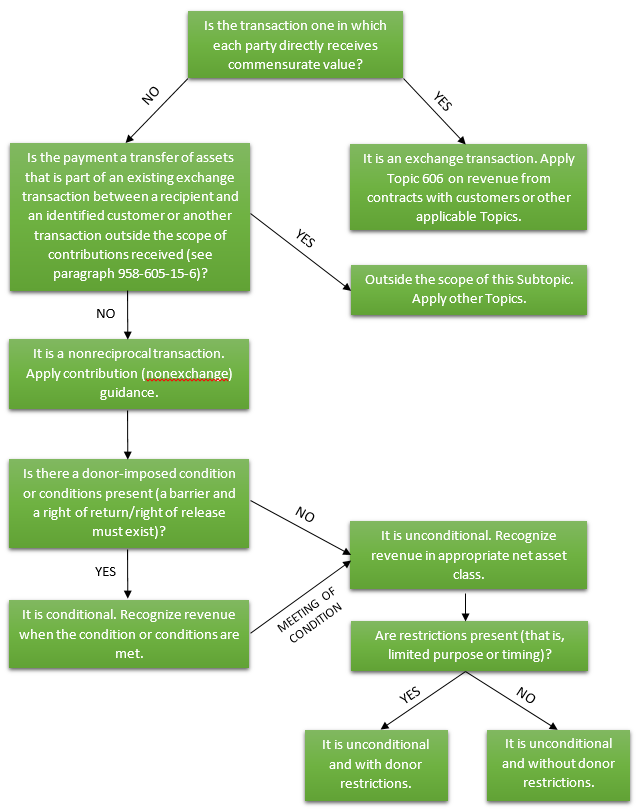
    The new guidance includes the following diagram to illustrate the process for determining if a transaction is a contribution, an exchange transaction or another type of transaction, and also whether a contribution is conditional or unconditional:

    Exchange or Contribution

    The first step in the flowchart is determining whether the transaction is reciprocal (exchange) or nonreciprocal (contributions) based on whether or not the resource provider (i.e. grantor) receives commensurate value in return for the transferred assets. The guidance states that benefits received by the general public do not equate to commensurate value being received by the resource provider. It also clarifies that executing the resource provider’s mission does not mean commensurate value is received. These types of transactions would generally be considered nonreciprocal under the guidance of ASU 2018-08. Further, if penalties assessed on a recipient for noncompliance with terms of an agreement are limited to the delivery of assets or services already provided and/or the return of the unspent funds, the transaction would generally be indicative of a contribution (nonreciprocal).

    Conditional or Unconditional Contributions

    Once the organization has determined a transaction falls within the contribution guidance, the next step requires organizations to assess whether the contribution is unconditional (and recognized in revenue immediately) or conditional (with revenue recognition being deferred). In determining if a contribution is conditional, the guidance focuses on whether the following exist: (1) a barrier the recipient has to overcome to be entitled to the assets, and (2) a right of return to the contributor for assets transferred or a right of release of the promisor from its obligation to transfer assets.

    The following are potential indicators and examples of barriers or conditions:

    1. Measurable performance-related barrier or other measurable barrier: agreement includes outcomes to be achieved within a specific time frame; recipient’s entitlement to resources is contingent upon a specified level of service, an identified number of units of output, or a specific outcome; recipient’s entitlement to resources is contingent upon an identified event (i.e. a matching requirement).
    2. Limited discretion by the recipient on the conduct of an activity: agreement includes requirements to follow specific guidelines about incurring expenses, requirements to hire specific individuals, or a specific protocol that must be followed.
    3. Stipulations related to the purpose of the agreement: agreement includes a requirement for a homeless shelter to provide a certain number of meals or an animal shelter to expand its facility to accommodate a certain number of additional animals. It is worth noting that stipulations unrelated to the purpose of the agreement are not indicative of a barrier (i.e. administrative or trivial stipulations, such as an annual reporting requirement or performance reporting requirement to demonstrate the organization took action to meet barriers listed in the agreement).

    When a contribution is determined to be unconditional, the last step of the process is to determine if there are any restrictions and to recognize the revenue within the appropriate net asset class (i.e. net assets with donor restrictions or net assets without donor restrictions).

    The FASB has indicated that the amendments in this ASU will likely result in more grants and contracts being accounted for as either contributions or conditional contributions than have been historically.

    Effective Dates

    For public business entities or not-for-profits that are conduit bond obligors, the amendments under ASU 2018-08 are effective for resource recipients for annual periods beginning after June 15, 2018. For all other entities, it is effective for annual period beginnings after December 15, 2018. Early adoption is permitted and amendments should be applied on a modified prospective basis.

    Source: FASB Accounting Standards Update 2018-18

  • Healthcare Webinar “Ask the Experts: Protecting Your Practice from Fraud”

    Healthcare Webinar “Ask the Experts: Protecting Your Practice from Fraud”

    Healthcare providers face numerous fraud and security risks, from embezzlement and theft to ransomware and data privacy. Implementing internal controls and complying with local, state, and federal regulations can be difficult for providers who already focus on a range of priorities, including patient care delivery, payer compliance, medical billing, and revenue cycle management.

    In this complimentary online webinar, our panel of experts will present accounting, legal, and risk management perspectives for protecting your practice.

    Learning objectives:
    • Analyze fraud and abuse prevention policies and compliance programs
    • Learn how to establish and maintain accounting controls and safeguards
    • Understand how to ensure patient privacy and safety
    • Learn how to mitigate risk and protect practice assets

    Watch the Webinar

    Presented by:

    Nicole McOmber, CPA
    Healthcare Advisor, Jones & Roth

    Jeremy Prickel, CPA
    Healthcare Advisor, Jones & Roth

    Logan Haugen
    Risk Management Expert, Ward Insurance

    Kevin Burgess
    Attorney, Watkinson Laird Rubenstein

    Dan Olson
    Attorney, Watkinson Laird Rubenstein